
FIRST INTERINSTITUTIONAL MEETING TO NEGOTIATE THE REGULATION ON PREVENTING CHILD SEXUAL ABUSE
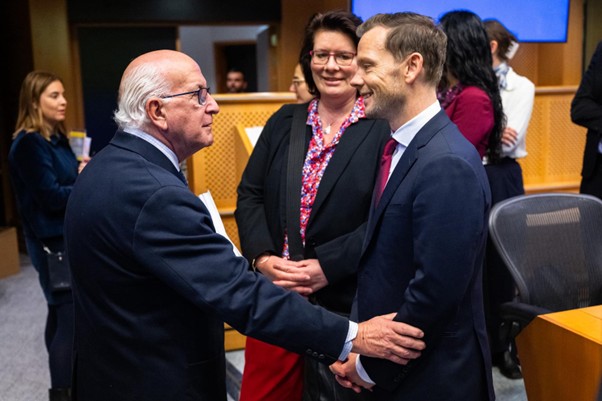
On 9 December, the European Parliament, represented by MEP Javier Zarzalejos, and the Council of the European Union, represented by the Danish Minister of Justice, Peter Hummelgaard, launched negotiations between the two institutions to agree on the Regulation on preventing and combating online child sexual abuse.
The protection of children is one of the fundamental objectives of the European Union, as set out in Article 3(3) of the Treaty on European Union. However, the most recent figures on child sexual abuse and exploitation show that current efforts are insufficient. UNICEF estimates that around 90 million children alive today have suffered sexual violence. In 2023 alone, according to the European Commission, 1.3 million reports were recorded in the EU, involving more than 3.4 million images and videos of child sexual abuse. Although a 30% drop in reports was observed in 2024—partly due to the expansion of end-to-end encryption—the overall volume remains alarming.
The Internet Watch Foundation (IWF) also warns that the EU continues to be the region of the world hosting the largest amount of child sexual abuse material, accounting for 59% of cases. This is compounded by an emerging phenomenon: the use of artificial intelligence to generate abusive material, which increased by 400% in the first six months of the year, particularly in video format.
In light of these figures, Zarzalejos stressed that a fragmented legislative response by individual Member States is not sufficient. To achieve a real reduction in the scale of the problem, the EU needs a stable, permanent, and common framework that imposes clear obligations on platforms to detect, report, and remove child sexual abuse material.
The European Parliament approved its negotiating mandate in November 2023, supported by all political groups. The Council of the European Union required three years to reach an agreement, which was achieved on 26 November 2025.
Zarzalejos explained that Parliament’s position includes measures addressing all forms of online abuse—known material, previously unknown material, and grooming cases—and предусматриes detection orders as a measure of last resort, while prioritizing prevention through age verification, parental controls, safety-by-design requirements, and specific measures for pornographic platforms and video games.
Parliament also supports the creation of an EU Centre, which is key to combating these crimes and to ensuring European strategic autonomy, avoiding reliance on foreign entities for the handling of reports. In addition, the mandate strengthens victims’ rights through a Consultative Forum of Victims and Survivors and promotes closer cooperation between competent authorities and Europol in order to deliver a coordinated response at European level.