
EUROPEAN DIALOGUES IN SAN SEBASTIÁN
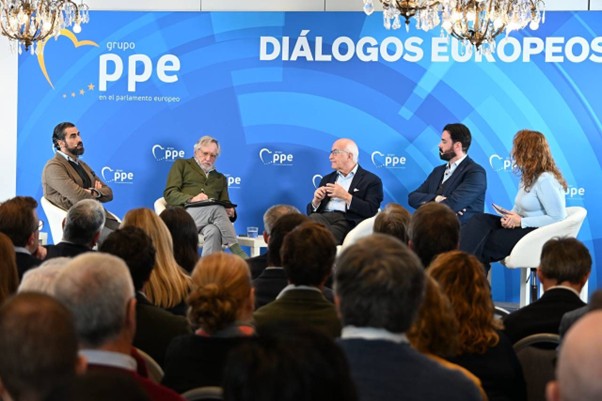
The delegation of the People’s Party in the European Parliament held the third edition of European Dialogues on November 8th in San Sebastián, a reflection forum that is becoming established as a space for analysis on the major challenges facing the Basque Country in a context of industrial transformation, energy transition, and demographic change. The event brought together institutional leaders, representatives of the private sector, and experts from academia.
In the opening session, Javier Zarzalejos, MEP for the People’s Party and Chairman of the Committee on Civil Liberties, Justice and Home Affairs of the European Parliament, highlighted the need to generate accurate assessments in the face of global and European changes. He stressed the importance of addressing challenges from a European, Spanish, and Basque perspective, and warned that the model promoted by Basque nationalism does not offer effective responses to key issues such as competitiveness, innovation, infrastructure, or institutional quality. He further warned that all these areas are undergoing progressive deterioration in the Basque Country due to the management of nationalists and socialists.
The first panel, titled “Human Capital: Immigration, Education System, and Talent Attraction,” moderated by Muriel Larrea, President of the People’s Party of Gipuzkoa, brought together the Engineering Director of Nordex Group, Iñigo Calderón; Francisco Llera, member of the Royal Academy of Moral and Political Sciences and Emeritus Professor of Political Science at the University of the Basque Country; Iñaki Ortega, Managing Director of Llorente & Cuenca in Madrid and Academic Director of CEOE’s leadership programs; and Javier Zarzalejos himself. The discussion focused on the educational, demographic, and migratory dimensions of competitiveness and on the situation currently faced by the Basque Country in these areas.
Speakers warned about the long-term deterioration of the Basque educational system, with a drop of between 25 and 30 points in PISA scores since 2009, compromising future productivity and the capacity to generate talent. They also analyzed the migration challenge, noting that 18% of Spain’s resident population was born abroad, and placed this issue within the framework of the new European Pact on Migration and Asylum, which will enter into force in June 2026. The exodus of young Basques—close to 20%—was another central issue in the discussion, with speakers emphasizing the need for effective policies to attract and retain talent in a competitive environment.
The second panel, titled “The Basque Country, Spain, Europe: The Challenges of Competitiveness,” featured MEPs Isabel Benjumea and Raúl de la Hoz; the President of the Basque People’s Party, Javier de Andrés; Iberdrola Spain’s Director of Regulation, Patxi Calleja; and the CEO of Petronor Alba Emission Free, Aitor Arzuaga. The session, moderated by Basque MP Álvaro Gotxi, examined the loss of economic and industrial weight in the Basque Country at a time when Europe is also falling behind the United States and China.
Speakers addressed European initiatives such as the Competitiveness Compass and the Omnibus regulatory package, aimed at boosting productivity and reducing administrative burdens. All of them agreed on the seriousness of the situation in the Basque Country, with an 11% industrial decline over the past decade and a GDP share that has fallen to 5.86% of the national total. They also pointed out the low implementation of the NextGenerationEU funds, as Spain has mobilized only 33%, a situation that is particularly affecting SMEs and strategic sectors. Among the conclusions, they emphasized the urgency of strengthening the industrial fabric and accelerating regulatory and energy modernization.
The event concluded with a remote intervention by Miguel Tellado, Secretary-General of the People’s Party, who warned about the lack of opportunities that is forcing many young people to leave the Basque Country and called for a change of course to recover economic and social dynamism. He also stressed that the PNV is complicit in the current situation of misgovernance in Spain. Finally, Javier de Andrés defended the need to place the Basque Country at the forefront of industry and education and to fully harness its potential.