
ANNUAL MEETING OF THE POLICE INTERGROUP
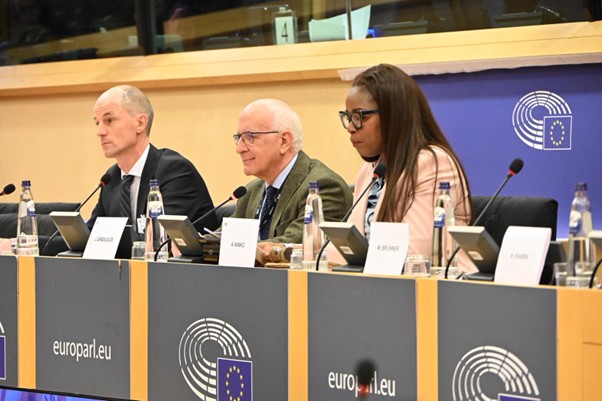
On 4 March, Member of the European Parliament Javier Zarzalejos took part in the annual event of the European Parliament’s Police Intergroup, chaired by Belgian MEP Assita Kanko. The meeting brought together around 300 police officers from different Member States in Brussels, along with institutional representatives and security experts, for a day dedicated to analyzing the challenges faced by law enforcement in the current context of hybrid threats and transnational crime.
During his speech, Zarzalejos, in his capacity as Chair of the European Parliament’s LIBE Committee, expressed explicit recognition of the daily work of police officers and emphasized that European security largely depends on law enforcement agencies, which are responsible for protecting streets, investigating criminal networks, preventing terrorism, and addressing new threats aimed at destabilizing European democracies.
The EPP MEP warned that Europe is facing an increasingly complex security environment, characterized by hybrid threats that combine infrastructure sabotage, cyberattacks, migratory pressure, and disinformation campaigns designed to erode trust in institutions. In this context, he stressed that police forces constitute the first line of response to these challenges and play a central role in the European Union’s security architecture.
Zarzalejos also defended the need to strengthen institutional support for police forces and reiterated his call to formally recognize policing as a high-risk profession across the European Union, with stronger legal protections, better working conditions, and resources adapted to 21st-century threats.
Finally, he highlighted the importance of preserving the principle of authority and respect for the rule of law, noting that an attack against a police officer is not only an attack against an individual, but also against the democratic institutions that law enforcement bodies protect and represent. He concluded by stressing that strengthening European cooperation and supporting those who ensure citizens’ day-to-day security is an essential condition for the stability and strength of European democracies.