
LIBE COMMITTEE CHAIR JAVIER ZARZALEJOS HOSTS CEUTA PRESIDENT JUAN JESÚS VIVAS’S PRESS CONFERENCE AT THE EUROPEAN PARLIAMENT ON THE CEUTA MIGRATION CRISIS
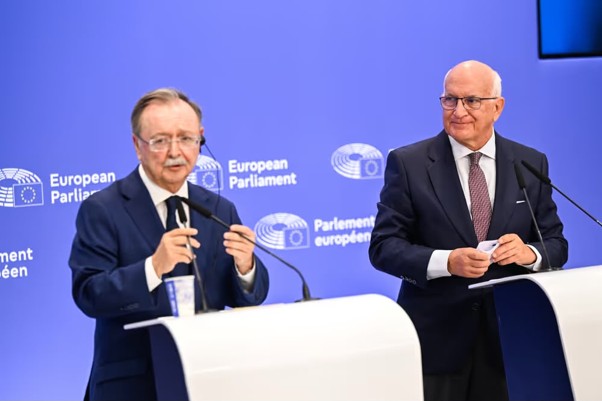
Javier Zarzalejos, Chair of the European Parliament’s Committee on Civil Liberties, Justice and Home Affairs (LIBE), hosted a press conference in Brussels by the President of Ceuta, Juan Jesús Vivas, on the migration crisis affecting the autonomous city since the end of July.
Vivas holds Morocco responsible for the mass influx
The President of Ceuta attributed the mass arrival of people to the actions of the Moroccan authorities, citing three factors: the practical impossibility of mobilising between 80,000 and 100,000 people without Rabat’s knowledge; reports by the Spanish police showing the Moroccan Gendarmerie directing migrants towards the border; and the precedent of May 2021, when Morocco had already used border control as an instrument of political pressure.
Contrast with the Spanish Government’s position
Asked by an Austrian journalist about the apparent reluctance of Sánchez’s Government to hold Morocco responsible, Vivas referred the question back to the Spanish Government, recalling that in 2021 its position had been “unequivocal”, whereas it was no longer so.
Humanitarian scale and lack of official figures
Vivas estimated that around 80,000 people entered Ceuta on 30 and 31 July — equivalent to the city’s entire population — and that more than 100 people died. He criticised the fact that, more than a month later, the Government had still not provided an exact official figure for the number of people who entered or the number remaining in the city — estimated at between 5,000 and 15,000 — nor information concerning their identities. The city is currently hosting 1,800 unaccompanied foreign minors, compared with a statutory allocation of 30, with the figure potentially reaching 3,000 before the process is completed.
Requests to the European Commission
Vivas called for a plan and a specific date for the return to Morocco of those who arrived on 30 and 31 July; a permanent presence in Ceuta by Frontex and the European Union Agency for Asylum; funding for border infrastructure and the humanitarian emergency, particularly the reception of unaccompanied minors; as well as recognition of a specific status for Ceuta and Melilla and adaptation of the Pact on Migration and Asylum to their unique position as Europe’s only land border in Africa.
Declassification of CNI reports and institutional unity
The President of Ceuta linked the declassification of reports by Spain’s National Intelligence Centre (CNI) to the need to establish what had happened, and thanked the Mayor of Jerez, María José García Pelayo, for relinquishing her seat on the European Committee of the Regions in order to give Ceuta and Melilla a direct voice.
Relocation of minors and the framework of the Pact on Migration and Asylum
During the question-and-answer session, both Vivas and Zarzalejos referred to the family reunification mechanism under the Pact on Migration and Asylum as the first option for unaccompanied minors, before considering solidarity-based relocation among Member States. Zarzalejos noted that the European Commission provides a legal framework, funding and Frontex resources which, in his view, have not been fully utilised by the Spanish Government.