
ZARZALEJOS MEETS WITH THE VICE PRESIDENT OF THE GOVERNMENT OF THE CANARY ISLANDS TO ADDRESS THE MIGRATION CHALLENGE
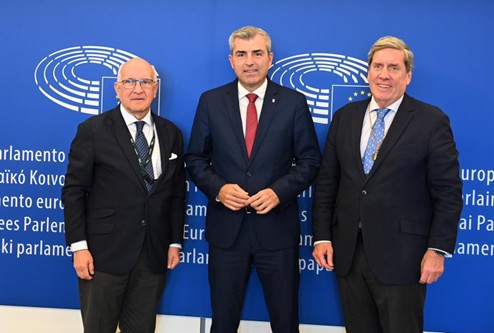
On Tuesday, April 7, Javier Zarzalejos, Member of the European Parliament, held a meeting at the European Parliament in his capacity as Chair of the Committee on Civil Liberties, Justice and Home Affairs (LIBE), with the Vice President of the Government of the Canary Islands, Manuel Domínguez, together with Canary Islands MEP from the Partido Popular, Gabriel Mato.
During the meeting, which focused on migration management, the participants recalled the mission carried out by the LIBE Committee last year to the island of El Hierro, where they were able to witness first-hand the migratory pressure and the severity of the situation at the southern border of the European Union.
The Canary Islands Vice President stated that European funds allocated to migration management are not effectively reaching the islands and denounced the lack of support from the Spanish Government in the face of the pressure borne by the archipelago.
Zarzalejos stressed the need for an effective and coordinated European response, in line with the Pact on Migration and Asylum, whose entry into force is scheduled for June this year. In this context, he placed particular emphasis on the future Returns Regulation, which will be binding on Member States and seeks to address one of the main weaknesses of the current system: the low rate of enforcement of return orders, which barely reaches 20% in the European Union. As he explained, the aim is to provide Member States with more effective tools, strengthen cooperation between countries, and streamline procedures to ensure that adopted decisions are effectively implemented.
Likewise, during the meeting, the proposal for large-scale regularization promoted by the Spanish Government was discussed. As highlighted, it raises serious concerns due to the lack of an impact assessment and a rigorous economic report, the devaluation of the concept of social integration (arraigo), and the absence of legal safeguards, as well as the fact that it has not been coordinated with European partners, which could have implications for the entire Schengen area.