
THE EUROPEAN PARLIAMENT PAYS TRIBUTE TO MANUEL GIMÉNEZ ABAD ON THE 25TH ANNIVERSARY OF HIS MURDER BY ETA
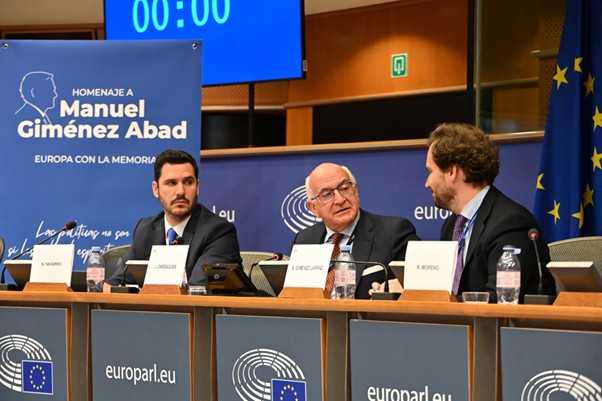
On 12 May, the European Parliament hosted a tribute to Manuel Giménez Abad in Brussels to mark the 25th anniversary of his assassination by ETA. The event was marked by remembrance, the defence of the memory of victims, and the reaffirmation of democratic values in the face of terrorism. The ceremony brought together institutional representatives, Members of the European Parliament, and members of the People’s Party (PP), including the President of the European Parliament, Roberta Metsola, the President of Aragón, Jorge Azcón, and MEP Borja Giménez Larraz, son of the Aragonese politician who was murdered in Zaragoza on 6 May 2001.
During his speech, Borja Giménez Larraz remembered his father as “a good man, a public servant, and an outstanding jurist,” who was killed for defending the principles of democracy and freedom. He also stressed the importance of preserving memory in the face of extremism and fanaticism, particularly among younger generations who did not experience the years of terror inflicted by ETA. The event included screenings of excerpts from the documentary Por la espalda (From Behind), directed by Silvia Ladrero, which reconstructs the attack and the subsequent investigation that ultimately solved the case years later.
The President of the European Parliament, Roberta Metsola, described Manuel Giménez Abad as a politician committed to “consensus and dialogue” and stated that he was “the antithesis of those who took his life.” For his part, Jorge Azcón highlighted the need to keep alive the memory of those who were murdered for defending democracy and warned that “neither violence nor hatred succeeded in erasing his example or his convictions.”
MEP Javier Zarzalejos also spoke at the tribute, stressing the need to analyse ETA’s terrorism in all its political, social, and criminal dimensions. Zarzalejos recalled that ETA was not “a group of madmen,” but rather a highly structured criminal organisation with financing networks, political support, and mechanisms of social control, driven by hatred. He further argued that democracy has a moral obligation to prevent those who justified or sheltered terrorism from benefiting politically from its legacy. “We owe it to the victims,” he stated, calling for a commitment to preserving memory, dignity, and justice against any attempt to whitewash terrorism.